on
LF02: Christopher Schmidt (EN)
I.
With Giver, Christopher Schmidt understands hardcore as a collective, socio-critical long-term project; with Between Bodies, he shifts the perspective toward the personal.
Christopher is from Paderborn, lives in Cologne, and has spent more than half his life in bands. This conversation revolves around origins and infrastructure, political socialization, Americanized scenes, European restraint, friendship as a foundation—and the question of what remains as you grow older.
II.
LF: Let me start here: We’ve really only known each other properly since New Native. But with Giver, you played a show with my former band Grey Years before that. That was one of your first shows.
CS: Yes, I think this was my first show abroad. I remember we got a request from Vienna and then drove there for a show. On the way there we played an 18th birthday in Frankfurt, and on the way back in Leipzig—both in front of maybe five people. We organized it all ourselves through a thousand connections. For us, it was really special to be asked to play a show in another country. But yeah, that’s when we first crossed paths.
LF: But Giver wasn’t your first band. Tell me more about Not Your Choice and your connection to Intruder.
CS: If I go way back, before Not Your Choice I had two other bands—a German punk band and an alternative rock band. Both were with Laurenz, who currently plays in Swan Songs. We started making music together at 13, and he still fills in on drums for Between Bodies.
Not Your Choice was my first hardcore band, and also the first one that got us out of Paderborn. For me, punk has always been tied to an emancipatory and political idea. Robin, the singer, was the first “left-wing person” I ever really got to know. We took down a few NPD posters in Paderborn—that was new and exciting for me. Robin had good connections to Intruder and got us our first shows in Kassel and eastern Germany through them. Over time, I also got into songwriting. After graduating, everyone moved away and the band broke up, but looking back, that period was very formative. This band showed me that I wanted to keep doing this.
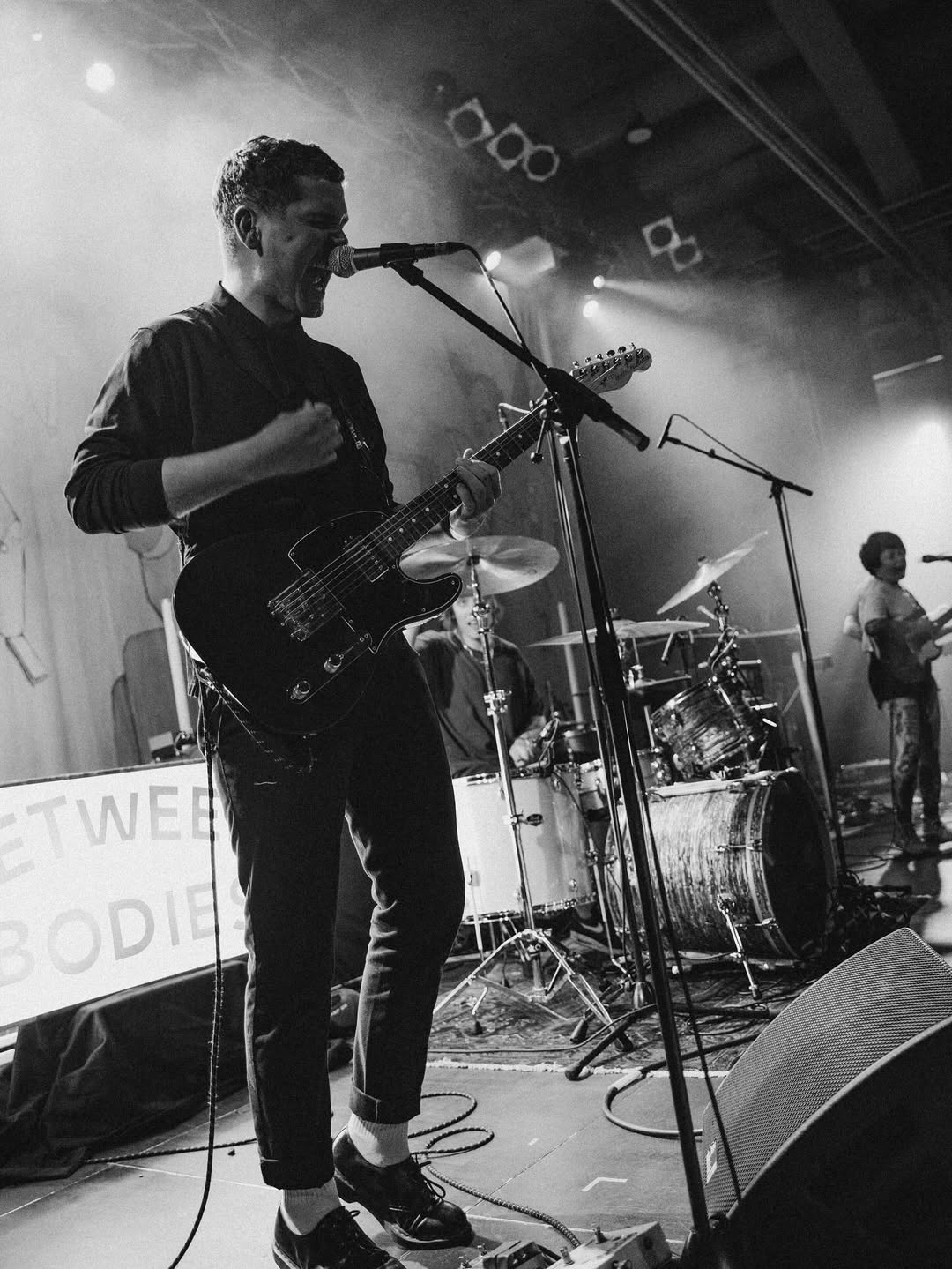 Christopher Schmidt live with Between Bodies. Colos-Saal Aschaffenburg. October 4, 2025. Photo by Sebastian Igel.
LF: You’ve been active in bands for more than half your life and devote a large part of your energy to writing, rehearsing, designing, traveling, organizing, and networking. In an interview, you said it’s “the easiest way for you to see your friends.” There are easier ways to see your friends in your thirties. Why keep doing it?
CS: In your thirties, that might be true [laughs]. With Giver, it really is a big friendship project—that’s what sustains the band. We don’t take that for granted, and we don’t know how long it will last. Julian [guitar] once said that “through the band, we were able to watch each other become the people we are today.” I think that’s very accurate. For the first time since forming the band, we’ve all been living in the same city for three years now. That makes it easier to get my best friends together in one evening. At the same time, we’re more mindful of our time so that our social and family lives in Cologne don’t fall short. Still, the band means a lot to me because making music is closely tied to community for me.
LF: Is Between Bodies a similar friendship project that keeps you going?
CS: It’s different with Between Bodies. It started as a side project between Benni [guitar, keys] and me. I already knew Benni from Giver. We just wanted to write an EP in the style of RVIVR, Spanish Love Songs, and Iron Chic. Nils [drums] is one of my oldest friends and a key reason why I listen to punk. He’s about eight years older, went to the same school, and used to wear a shaved mohawk. I picked up bands like Set Your Goals and Strike Anywhere from his shirts and buttons. We met Susan [guitar] at a show at Aether and asked if she wanted to join the band. Then COVID hit, which made getting to know each other during the early phase much harder. I’d say that only really happened over the past two years. With our second album, I felt that we really came together on multiple levels.
III.
LF: You also write for both projects. How does songwriting differ between Giver and Between Bodies?
CS: The big difference is that in Giver, Julian, Benni, and I co-write—we live in the same city, and Julian and I lived together for a long time. I could walk into his room with an idea and develop it together. Even now, it’s easier to meet regularly in the rehearsal space and write collectively. For the last album, many songs simply emerged from playing together—often it was enough for one of us to bring a rough idea.
With Between Bodies, it’s different because Nils lives in Paderborn. We hardly rehearse. I tend to write songs alone, go through multiple feedback loops with myself, and sometimes record a proper demo before sending it to the band. Usually, I develop songs further with Benni first—via chat or over coffee—before we take them into the rehearsal room. We tab everything out in GuitarPro, even if it’s painful [laughs]. But it allows us to meet for a focused rehearsal week and dive straight in.
LF: How do you decide when a song is ready to share with the band?
CS: For the new Between Bodies album, I wrote a lot starting from the vocals. Some songs were heavily reworked in the rehearsal space, others not. Benni also contributed a full song this time, “False Start”, and was very involved in vocal arrangements, synths, drums, and structure. But usually, I create a draft, make a demo, and bring that into the rehearsal room.
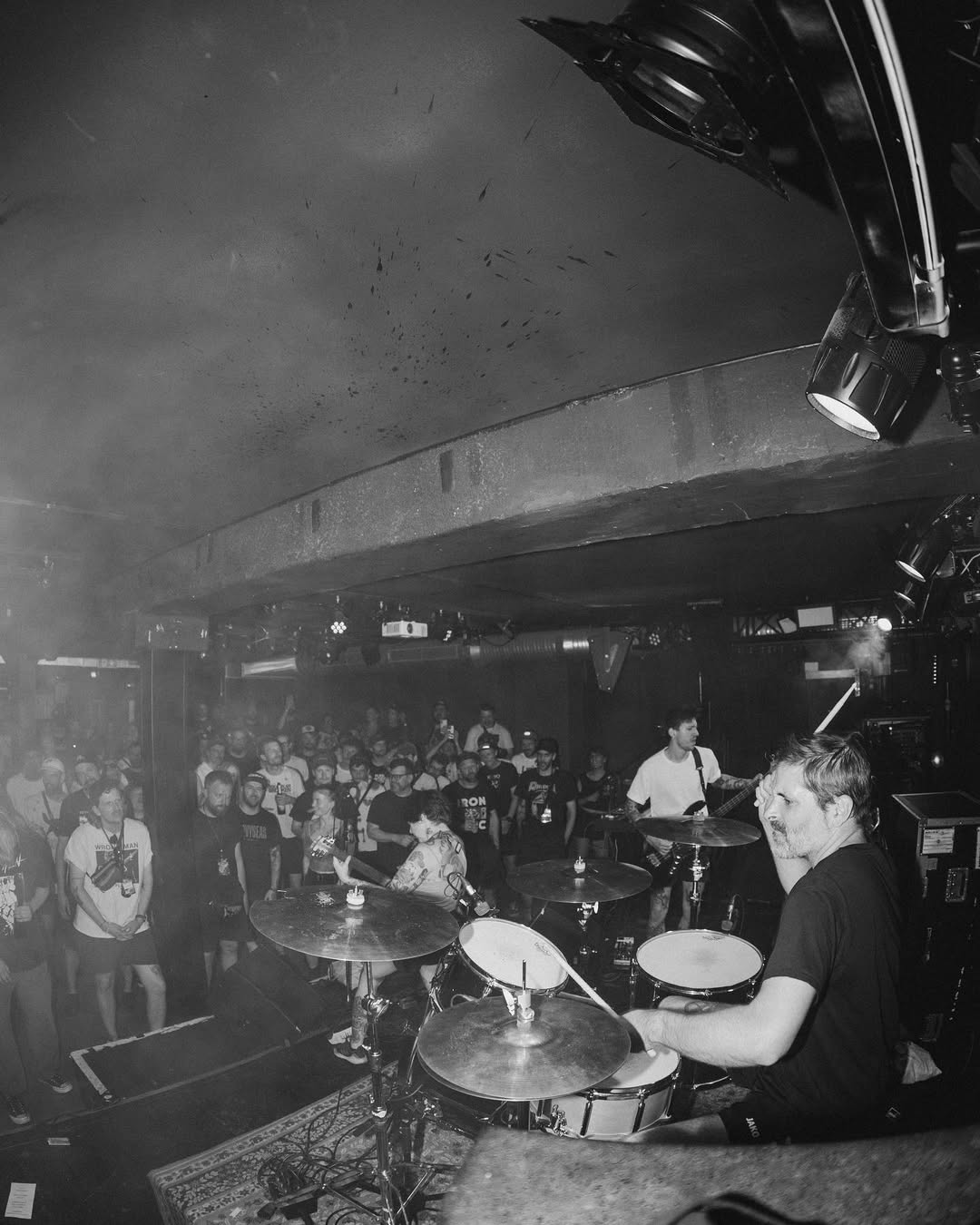 Between Bodies live at Farewell Youth Fest. Scheune Dresden. Jun 21, 2025. Photo by Sebastian Igel.
LF: How do you see the idea that a good song can only be “received,” and that as a songwriter you can’t actively influence much?
CS: I’ve moved away from that romanticized view of creative work. I owe that to Adrian, a former Giver member who now works as a film composer. He said you just have to sit down and do it if you want something to come out—and he’s absolutely right. You have to create the space for it. The hard part is pushing through all the bad songs you inevitably write before arriving at a good idea. You have to be willing to write things that end up not being used.
Since lyrics are very important to me, I write constantly. I have an archive in a Telegram channel with myself and in various Word documents where I collect ideas. I read books with a highlighter to gather interesting passages. But honestly, the best lines rarely come from that—they usually appear spontaneously while playing a song. Still, the archive helps break writer’s block.
With Giver, I often approached things a bit too intellectually because I needed a very clear idea before I could start writing. With Between Bodies, it’s more relaxed because the songs are more personal—but I still have to sit down and develop an idea. After that, I write very iteratively, constantly improving parts I’m not satisfied with. I spend a lot of time on lyrics.
LF: This sounds like you focus more on content than on how the words sound.
CS: Yes, but it’s a compromise. The ideal state where both align perfectly is rare. The older I get, the more I write vicals-first—probably because I feel more comfortable with my voice. I try to leave space for vocals in songs instead of fully mapping everything instrumentally first. Only then do I start writing lyrics. For this Between Bodies album, there was also a lot of feedback on the lyrics because they matter to Nils, Benni, and Susan as well. I really value that everyone contributes and sees lyrics as an essential part of the songs. It makes the songs feel more like a collective result and takes away some of my uncertainty.
LF: Does streaming culture and shorter attention spans influence your songwriting?
CS: We do discuss how long songs should be to fit listening habits, and we make sure every part actually serves the song. Structure and length should serve the song. We’ve also stopped asking ourselves things like which track would open a B-side well [laughs]. What matters is that the sequencing makes sense and the album feels coherent. This time, we figured that out before going into the studio, which allowed us to think more about transitions. A key question for me is always how a record begins and ends.
LF: How do you see the growing importance of visual identity through social media and video, possibly at the expense of musical identity?
CS: I used to think visuals were overrated, but now have a lot of respect when artists manage to extend their aesthetics with a coherent visual component. The cover artwork, in particular, plays a key role for me. We will shoot new videos for the new record too, but no one is really excited about it [laughs]. On social media, personality often takes center stage—even if that’s less pronounced in punk and hardcore. I find that somewhat annoying and have mixed feelings about it. Personally, I still find bands that represent a real group of characters more compelling than highly stylized solo artists, who don’t really exist that way behind the scenes anyway.
IV.
LF: To wrap up, let’s look at the European scene. Why do you think European punk and hardcore are more known for infrastructure and DIY networks than for artistic contributions?
CS: That’s a fascinating question I’ve been asking myself since COVID [laughs]. Of course, Germany has great DIY infrastructure—squats, autonomous centers, youth clubs, often state-funded. That simply doesn’t exist in most countries. But I also think the scene is becoming increasingly Americanized and therefore more exclusive. You need a very good command of English to participate. Sometimes it also feels like American and British bands take their projects more seriously. I notice it in myself too—you’re studying, working, and are also in a band. Whereas many Americans structure their lives around the band, almost like: “you don’t have health insurance anyway, so you might as well do what you really want” [laughs].
We’re often in a position where the impulses come from another linguistic space, and we just reproduce them. Of course, Between Bodies could sing in German, and economically that might even make more sense. But if you want to play with the bands that influenced you and maybe tour internationally, you can’t avoid English. I often wonder what the right path is to develop a distinct European version of these genres that still works in English.
It’s also still difficult for European bands to tour the US due to visa regulations and costs. It’s much easier the other way around, which means fewer European bands get that experience and build infrastructure. I also think booking agencies have a responsibility to value hard-working European bands more, instead of “just” putting them on as openers—even when they draw several hundred people. Often, three American bands come over and, regardless of their size, the local band opens. A good example is Shoreline from Münster, who are a fantastic European punk band and recently toured with Arm’s Length. There is a clear imbalance in perception and appreciation when people assume that a band from the US is inherently more valuable.
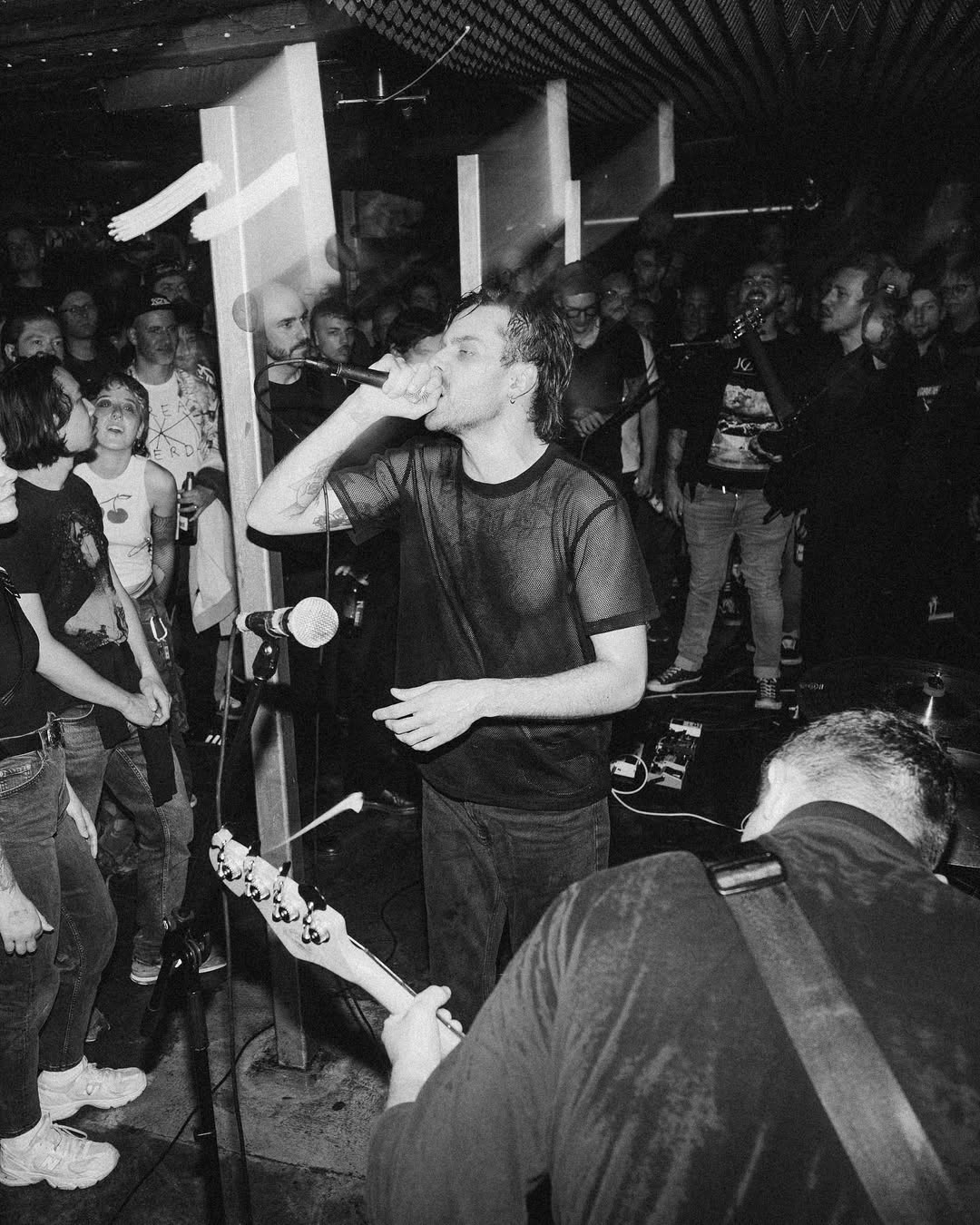 Giver live. K19, Berlin. October 26, 2024. Photo by Sebastian Igel.
LF: One could also use those existing networks and infrastructure more actively to position European bands that deserve it—also to act as an example for the next generation.
CS: Exactly—and you need both. Good music alone isn’t enough; you also need a genuine interest in people. A positive example is Echo Chamber, who have also played in many bands for over 15 years, organized shows, built relationships, write great songs, and are an incredible live band. After a few years, they were able to do some great US tours.
LF: Finally, what do you wish for the European scene?
CS: More courage to invest artistically—more people willing to put serious work into truly great songs, even if nothing comes of it.
And I’d like to see more interest from other countries. Last year we played with several US bands, and no one even thought about connecting with labels or bookers or taking a band along for more than two German shows. A friend who used to play in Punch always joked about how German bands try to play in the US but rarely succeed.
I think we need more openness—not just toward Europe, but toward other regions as well. For them it’s even harder. A global scene that’s genuinely interested in each other—that should be our goal.
Coda
Between Bodies — Water As A Metaphor/Waves